Roller screws are often perceived as having a standard planetary gear design, but in reality, there are several variants, including differential, recirculating, and inverted types. Each design offers distinct advantages in terms of performance—load capacity, torque, and positioning accuracy—but the primary benefit of the inverted roller screw lies in its ease of integration into actuators and other subassemblies.
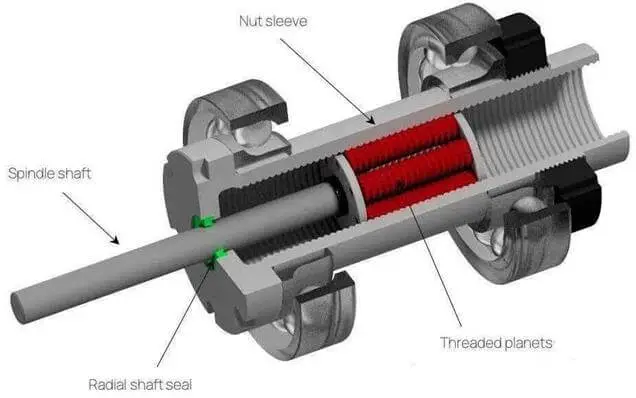
A standard roller screw (also known as a planetary roller screw) uses threaded rollers with teeth on their ends that mesh with gear rings at both ends of the nut. For the inverted roller screw, the functions of the screw and nut are swapped, or inverted. The nut is essentially a tube threaded on its inner diameter, and its length is no longer just sufficient to accommodate the rollers and meshing gear rings but matches the stroke length. Furthermore, the shaft of the screw is not threaded along its entire length, but only for a length equal to that of the rollers.
For an inverted roller screw, the nut length determines the stroke, while the threaded portion of the screw equals only the roller length.Therefore, when the screw shaft rotates, the nut and rollers do not translate along the length of the screw but remain axially stationary on the screw (i.e., the rollers and nut do not move along the screw's length). Instead, rotating the screw shaft causes the rollers—and the screw itself—to translate along the length of the nut. Alternatively, through the inverted roller screw design, the nut can be driven while the screw (and rollers) remain axially stationary.
Since the gear rings typically located at the ends of the nut are now moved to the ends of the screw's threaded portion, the nut diameter can be slightly smaller than that of an equivalently sized planetary roller screw. Although machining threads inside the relatively long nut body can be challenging, inverted roller screws can have fewer thread starts than standard planetary roller screws, meaning they can use larger threads, thereby offering higher load capacity than standard designs.
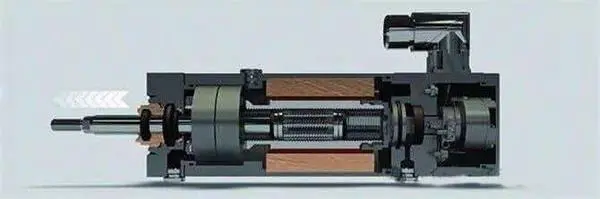
Inverted roller screws are ideal for linear actuators, where a rod extends from and retracts into the actuator housing. Since most of the screw shaft is unthreaded (only the portion where the rollers reside is threaded), the shaft can be customized according to the actuator's design and application requirements. The inverted design also enables actuator manufacturers to relatively easily attach magnets to the roller screw nut and use it as the rotor in an integrated motor-screw assembly.
The rollers in an inverted or reverse planetary roller screw also have gears on their ends, but these gears mesh with gears on the screw shaft (rather than on the nut ends as in the standard product). This causes the rollers to move axially within the nut, thus requiring an elongated nut to accommodate the full stroke of the assembly. In essence, the nut is fundamentally a long tube with a threaded inner diameter. Because the roller array is always fixed to a short segment of the screw shaft, only this segment is threaded; the rest of the screw shaft is a smooth steel or other material rod. Depending on the motor connection and design, the output can be taken from either the screw shaft or the nut.
Inverted roller screws may cost more than other types due to the need for precision thread machining along the long inner diameter of the nut. In some cases, these threads also have relatively low hardness, which can reduce load ratings to some extent; additionally, they may require special lubrication procedures. However, inverted screw structures are typically more compact than other roller screw designs.
Other standard roller screw actuators focusing on compactness fix the motor magnets to the outer diameter of the nut. The motor stator windings are then incorporated into the inner diameter of the actuator housing, surrounding the nut and creating electromagnetic interaction with the magnets. This, in turn, drives the nut to rotate and advances the actuator shaft via the rollers. While some manufacturers often tout the compactness of inverted roller screws as their main advantage, for linear actuator applications, the ability to customize the unthreaded portion of the screw shaft gives them a significant edge over other screw designs.
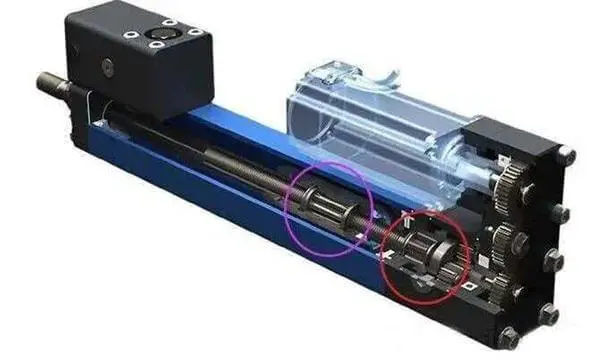
In high-force applications, electric linear actuators employing ball screws or roller screws offer numerous advantages over hydraulic actuators. These include higher energy efficiency, better accuracy and repeatability, smaller system footprint, quiet operation, minimal environmental impact, lower maintenance, reduced lifecycle costs, and the potential for process improvements leading to increased output and lower unit costs.
● Higher Energy Efficiency – Electric actuator systems typically achieve efficiencies between 75% and 80%. In contrast, pneumatic systems usually range from 10% to 25% efficiency. Hydraulic systems typically fall between 40% and 55%. Many factors affect fluid power efficiency, including temperature, seal integrity, leaks, and more. A key factor is that electric actuators only supply power to the drive motor when needed. When stationary, an electric actuator requires minimal current to maintain its position. On the other hand, hydraulic actuators require a power unit or compression system to continuously pressurize the fluid medium, leading to inefficient energy use. Over time, energy savings become significant.
● Higher Accuracy and Repeatability – In applications requiring precise motion and position control, actuators using electric ball screws or roller screws hold a distinct advantage. Standard hydraulic actuators are suitable for end-to-end positioning, but mid-stroke positioning is more complex, requiring control valves and operator assistance. More advanced servo-hydraulic control systems can provide higher accuracy and repeatability for hydraulic systems, but at a substantial increase in cost and complexity. Electric actuator systems are much simpler and, once programmed, require almost no manual intervention or maintenance.
● Quiet Operation – Noisy power units operating hydraulic cylinders can create noise pollution and pose hazards to operators working near the machinery.
● Minimal Environmental Impact – Hydraulic system leaks can create messy production environments and safety hazards if someone slips on the spilled fluid. Pneumatic system leaks generate noise and waste energy. Hydraulic leaks can also cause serious contamination in critical processes and products, such as in food processing, pharmaceuticals, medical devices, etc. Electric actuator systems are free from these drawbacks.
● Smaller System Footprint – Electric actuator systems not only save energy but also space. Hydraulic systems require cylinders, a power unit to provide pressure, control valves, filters, and many other components. Electric systems only need the actuator itself and a control cabinet—often conveniently placed near the point of use.
● Very Low Maintenance – Properly sized electric actuators typically require almost no maintenance. In more demanding performance applications, some maintenance like degreasing may be needed for electric actuators, but this is usually an infrequent, simple, and low-cost procedure. While hydraulic units are often rugged and easy to deploy, they require significant maintenance as a trade-off. Seal leaks can contaminate the workspace and reduce working force. Additional air and fluid maintenance is also necessary to prevent moisture or contaminants from prematurely damaging seals and other system components.
● Enabling Process Improvements – In many applications, electric actuators can cycle faster than hydraulic cylinders. For example, consider a hydraulic rod actuator needing to move six inches back and forth. Perhaps the application only requires a six-inch stroke for setup, while production runs only need three inches. However, with poor positioning capability, the hydraulic actuator can only move the full six inches each cycle, wasting time. An electric actuator with precise position control can be programmed to execute a three-inch production stroke, saving time and increasing production efficiency.
Lower Lifecycle Costs Compared to Hydraulic Systems – Although electric actuator systems can be twice as efficient as hydraulic ones, their initial deployment cost may be higher. However, when factoring in performance improvements, increased system flexibility, reduced maintenance costs, process enhancements, and lower utility costs, the total lifecycle cost can be significantly lower. The compact power of Inverted Roller Screws can enable High-Force Electric Linear Motion. It is a better solution.

