The centrifugal fan is a core component of modern ventilation systems, and its operational noise directly impacts equipment quality and user experience. This article systematically analyzes its noise types, with a focused discussion on how to optimize two key components—the blades and the volute tongue—by leveraging modern simulation technology to achieve effective noise reduction at the source.
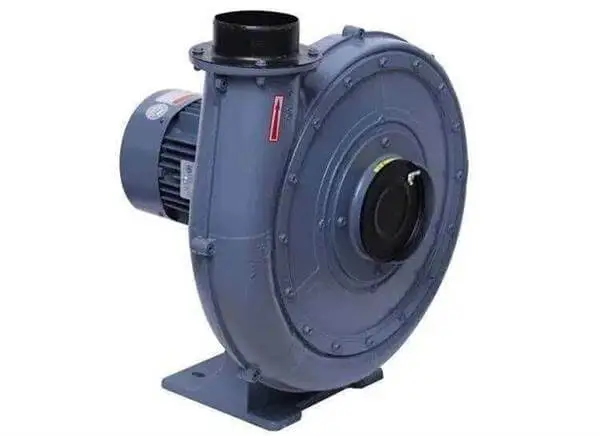
Accurate identification of noise types is the first step in noise reduction. The noise of centrifugal fans originates from the complex internal flow.
> Cause: Generated by the periodic passage of blades past stationary components, especially the volute tongue. Each blade passing creates a periodic disturbance to the airflow, forming pressure pulsations.
> Characteristics: The frequency spectrum shows distinct peaks at the blade passing frequency and its harmonics, manifesting as a low-frequency "humming" sound. Transient flow field simulations can clearly capture the periodic pressure pulses generated near the volute tongue as blades pass, which is the direct source of discrete noise.

Generated by random internal turbulent motion, primarily including:
> Turbulent Boundary Layer Noise: Random pressure fluctuations generated as airflow passes over the blade surface.
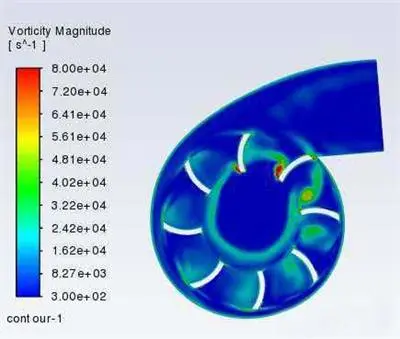
> Flow Separation Noise: Noise caused by the generation and shedding of vortices when airflow separates from the suction side of blades or the volute casing wall.
> Characteristics: The spectrum is continuously distributed without prominent peaks, appearing as a "hissing" background sound. The generation and evolution of these turbulent vortex structures can be intuitively observed in transient CFD simulations using vorticity contour plots.

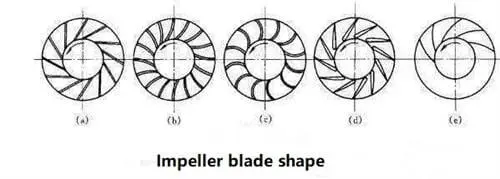
Blades are the "heart" of the fan, and their design determines the flow quality in the main stream.
> Forward-Curved Blades: Prone to generating large areas of flow separation within their flow passages, leading to vortex clusters and high broadband noise levels.
> Backward-Curved Blades: Feature smooth streamlines, effectively suppressing flow separation. Therefore, backward-curved blades are the flow-validated preferred choice for applications pursuing low noise.
> Blade Thickness: Flow simulation at the blade leading edge shows that a thicker leading edge acts like a blunt body, causing immediate airflow separation and generating strong vortex shedding noise.
> Airfoil Optimization: Using streamlined airfoil blades results in more uniform surface pressure distribution, allowing air to attach smoothly and fundamentally reducing vortices and broadband noise.
The volute tongue is the "epicenter" of discrete noise and a key focus for simulation-driven optimization.
> Simulation Finding: When the clearance is too small, transient pressure contour plots reveal extremely high instantaneous pressure gradients at the tongue, corresponding to pressure pulsation signals with very large amplitudes, resulting in abnormally sharp discrete noise.
> Optimization Direction: Appropriately increasing the tongue clearance through parametric simulation is the most direct method to weaken these pressure pulsations and reduce discrete noise.
Tilted Tongue: Comparing the transient pressure fields of straight and tilted tongues reveals that the tilted design disperses the concentrated, transient pressure impact into a gradually varying pressure process over time and space. Spectral analysis of this process shows that the discrete noise peaks are significantly smoothed and reduced.
We quantify the optimization effects through a complete simulation workflow.
> CFD Model: A full 3D model is established in ANSYS Fluent, using the transient SST k-ω turbulence model to accurately capture unsteady flow structures.
> Acoustic Model: Based on the Ffowcs Williams-Hawkings (FW-H) acoustic analogy theory, the flow field data (pressure, velocity) obtained from CFD calculations are used as noise sources to compute far-field noise.
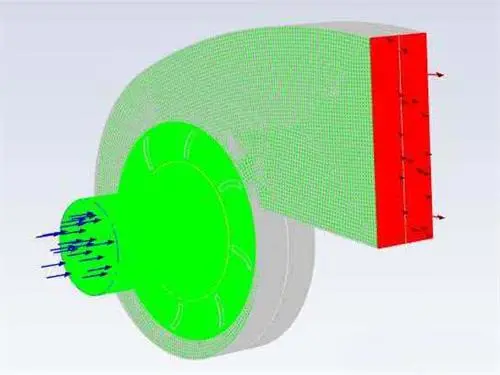
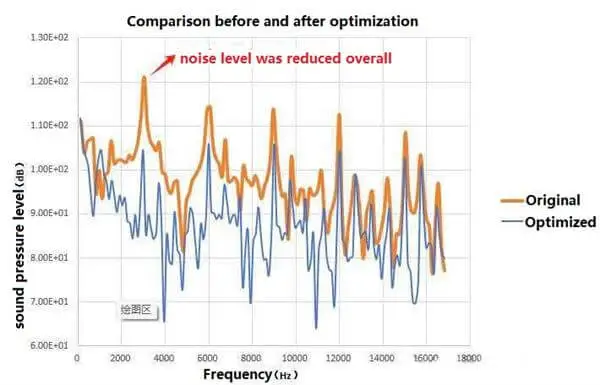
By changing the blades from forward-curved to backward-curved, modifying the blade shape to an airfoil profile, and altering the volute tongue to a large arc shape, the original centrifugal fan structure was optimized. Comparison results show that the optimized model achieved a reduction of approximately 15 dB in the sound pressure level peak at the blade passing frequency. Across the full frequency range, the noise level was reduced overall by 5-10 dB.
Noise reduction in centrifugal fans must be based on a deep understanding of the internal flow field. Modern CFD simulation technology provides a powerful tool for observing flow details and locating noise sources. Through simulation-driven analysis, this article demonstrates that backward-curved airfoil-type blades can effectively improve the main flow field and suppress broadband noise.

